Easy cursive words for beginners
The best first cursive words use only the easiest letters: the undercurve letters i, t, u and the c-family letters a, c, d, g. Words like it, at, cut, cat and glad join at the baseline every time, so a child can focus on one smooth stroke from start to finish instead of fighting tricky joins.
Printable worksheet
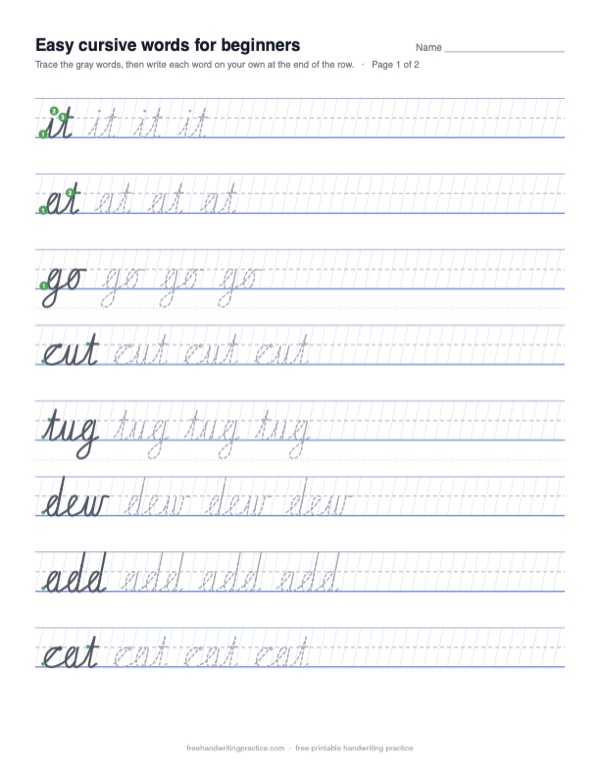
All 14 words in cursive, each on its own row: a dark model with start dots, gray copies to trace, then room at the end of the row to write it alone. Faint slant lines show the lean.
Or trace it on an iPad or phone
Trace with an Apple Pencil or a finger, then press Check for instant feedback on the path, the stroke order and the size. It runs in the browser, with no app and no sign-up.
- Trace the word
- Trace the light word
- Write it on your own
On-screen tracing is made for an iPad or phone
With a mouse or trackpad, tracing does not train the hand. Print the worksheet above and practice with a pencil. To trace with an Apple Pencil or a finger, scan the code with your tablet or phone camera to open this page there.
The 14 words
it, at, go, cut, tug, dew, add, cat, lid, tall, tell, glad, cute, gate
Why these letters come first
Most cursive programs teach letters in families, grouped by how they start. The undercurve family (i, t, u, w) all begin with the same swing up from the baseline. The c-family (c, a, d, g, o) all begin by curving up to the midline and circling back to the left. Learn one stroke and you get four or five letters with it.
e and l are added early because they are the same loop in two sizes: a small one for e, a tall one for l. With those eleven letters a child can already write dozens of real words.
Why some letters wait
b, o, v and w end at the midline instead of the baseline, so the letter after them has to start higher. That is a new skill, and it is easier once baseline joins feel automatic. In this set, o and w only appear at the end of a word, where nothing joins after them.
r, s, z, f, k, q and x have extra points, loops or lifts that slow beginners down. Save them for after these words look even.
A simple routine
- Say the word, then name each letter out loud.
- Trace it slowly, watching where each letter starts.
- Write it once on your own without lifting the pencil.
- Compare with the model: same height, same slant, even gaps.
- Do three or four words a day rather than all of them at once.
Cursive alphabet A to Z · Cursive sentences · Make a cursive sheet with your own words · Cursive paper