Pre-writing worksheets
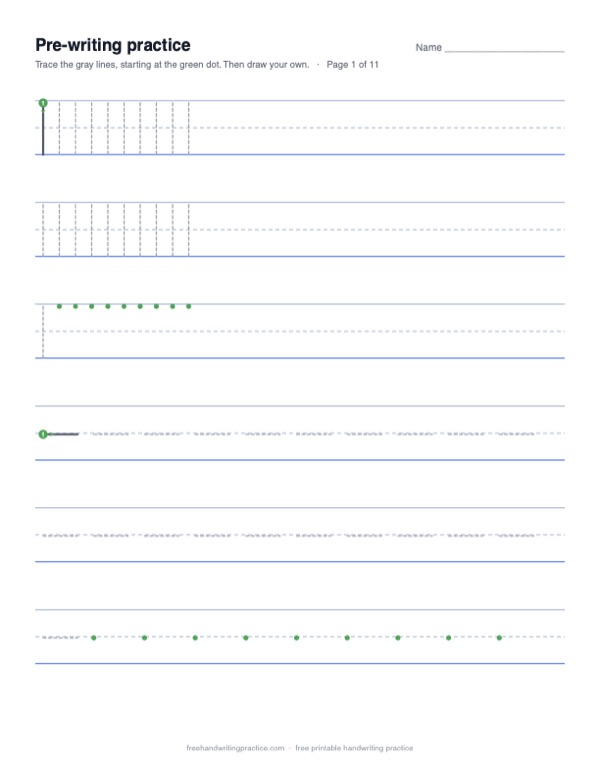
Before letters come lines and shapes. These free tracing sheets for ages 3 to 5 go from standing lines to stars, in the order children usually learn them. Every stroke starts at a green dot, so the right direction becomes a habit before the first letter.
- Tracing straight lines
- Tracing slanted lines
- Tracing crosses and X
- Tracing circles
- Tracing curved lines
- Tracing zigzag lines
- Tracing wavy lines
- Tracing loops and bridges
- Shape tracing: circle, square, triangle, rectangle
- Tracing more shapes: oval, diamond, heart, star
The whole packet in one PDF
All 21 lines, curves and shapes from the sheets above, each with a model row, a tracing row and a row of start dots.
What pre-writing skills are
Pre-writing skills are the lines and shapes children need to control before they can form letters: standing, sleeping and slanted lines, crosses, circles, curves, zigzags and simple shapes. Every letter of the alphabet is made of them. A child who can copy a cross, a square and a triangle usually has the control for most capital letters.
In what order
These are typical ages, not tests. Children move faster with daily, short practice: five minutes, a few rows, then something else.
- Standing and sleeping lines, around ages 2 to 3.
- Circles, around age 3.
- Crosses and squares, around age 4.
- Slanted lines, X and triangles, around age 5.
- Zigzags, waves, loops and bridges, then letters.
Before the pencil
Fine motor strength matters as much as the lines: playdough, building blocks, pegs, tearing paper and picking up small things with tongs all build the hand muscles a pencil needs. Short crayons and pencils encourage a tripod grip. Tracing on a tablet with a finger is a good warm-up, but some pencil on paper every day is what builds handwriting.
Ready for letters? Go on to letter tracing A to Z, and celebrate with a free Super Tracer certificate.