Uppercase letter tracing A to Z
All 26 capital letters on two pages, in alphabet order. It is the sheet to print when the letters have been met one at a time and it is time to see the whole uppercase alphabet together, or to find out which capitals a child already knows.
Printable worksheet
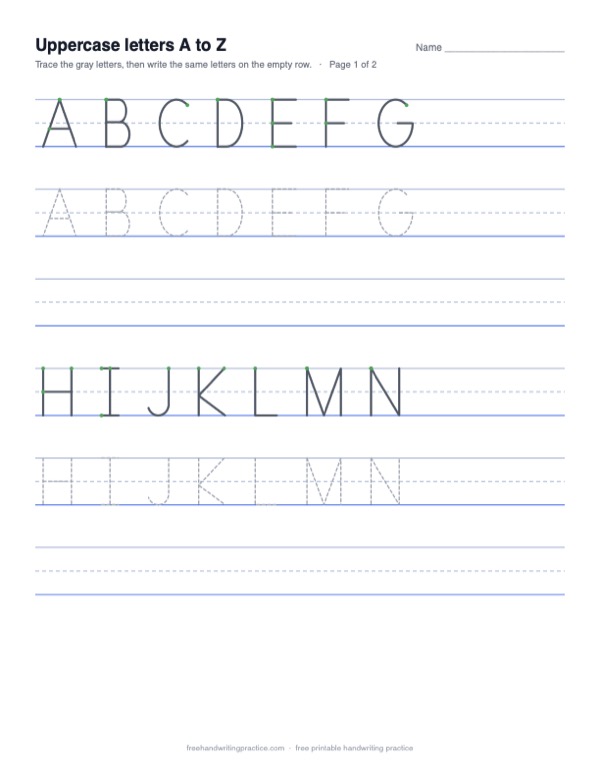
Two pages: A to N on the first, O to Z on the second. The letters come in rows of six or seven. Each row is printed dark with a green dot where every stroke starts, then in gray to trace, then left empty to write the same letters alone.
Or trace it on an iPad or phone
Trace with an Apple Pencil or a finger, then press Check for instant feedback on the path, the stroke order and the size. It runs in the browser, with no app and no sign-up.
- Trace the letter
- Trace the light letter
- Write it on your own
On-screen tracing is made for an iPad or phone
With a mouse or trackpad, tracing does not train the hand. Print the worksheet above and practice with a pencil. To trace with an Apple Pencil or a finger, scan the code with your tablet or phone camera to open this page there.
The capitals, sorted by their lines
- Standing and lying lines only: E, F, H, I, L and T. These are the easiest to start with.
- A tall line and a curve: B, D, J, P, R and U. R adds a slanted leg.
- Curves: C, G, O, Q and S. G adds a short flat line and Q a short slanted tail.
- Slanted lines: A, K, M, N, V, W, X, Y and Z. Slants are the hardest lines for small hands, so these usually come last.
One start rule for the whole page
Every capital on these worksheets starts on the top line, or just below it for C, G and S, which begin with a curve. None starts at the bottom. A child who has that one rule, start at the top, will form most capitals correctly without being told anything else.
All 26 are also the same height, from the top line to the baseline. That is why capitals are easier to line up than lowercase letters, which come in three heights.
How many strokes
Ten capitals are written without lifting the pencil: C, G, J, L, O, S, U, V, W and Z. Eleven take two strokes: B, D, K, M, N, P, Q, R, T, X and Y. A, F, H and I take three, and E takes four: the tall line, then three bars.
On the dark row, count the green dots on a letter to see how many strokes it has.
Using the sheet
For a first run, trace the gray rows only and leave the empty rows for another day. To check what a child knows, fold the page so only an empty row shows, say a letter, and have them write it from memory. The letters that come out reversed or from the bottom up are the ones to practice on their own pages.
Keep going
- The other half of the alphabet: lowercase letter tracing a to z
- A full page for each letter: alphabet tracing packet
- Capitals at work: trace a name