Tracing slanted lines
Slanted lines are harder than straight ones, because the hand has to move down and sideways at the same time. Most children manage them between ages 4 and 5. They are the strokes of A, K, M, N, V, W, X, Y and Z. Trace both kinds, always starting at the top.
Printable worksheet
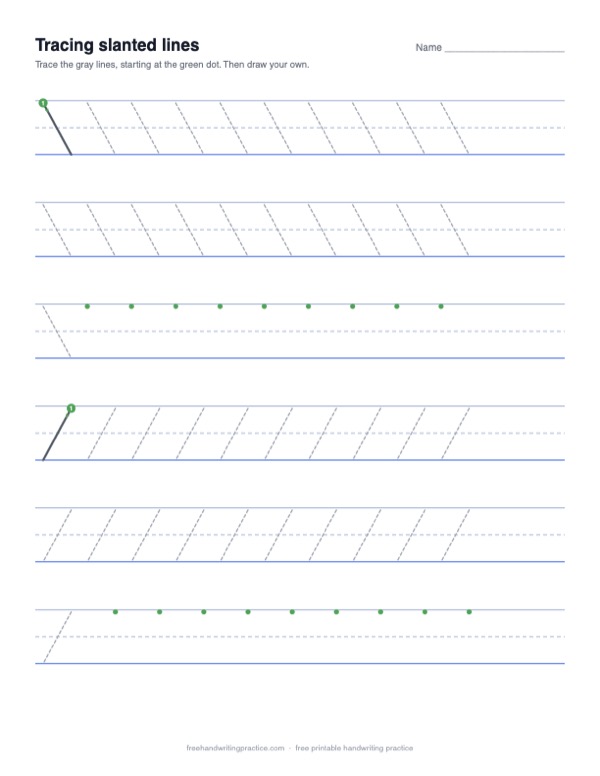
The slide down to the right and slide down to the left: for each one, a row with a dark model (numbered green dots and an arrow show where to start and which way to go), a row of gray copies to trace, and a row with only green start dots to draw it alone.
How to draw each one
- Slide down to the right: Start at the top left and slide down to the bottom right.
- Slide down to the left: Start at the top right and slide down to the bottom left.
Letters that use these strokes: A K M N V W X Y Z k v w x y z.
Or trace it on an iPad or phone
Trace with an Apple Pencil or a finger, then press Check for instant feedback on the path, the stroke order and the size. It runs in the browser, with no app and no sign-up.
- Trace the stroke
- Trace the light stroke
- Write it on your own
On-screen tracing is made for an iPad or phone
With a mouse or trackpad, tracing does not train the hand. Print the worksheet above and practice with a pencil. To trace with an Apple Pencil or a finger, scan the code with your tablet or phone camera to open this page there.
Slides, not lines
Call them slides: a slide down to the right and a slide down to the left. Children know that you never climb up a slide the wrong way, and the picture keeps them starting at the top.
The slide down to the left is usually the harder one, especially for right-handed children, because the hand covers the line it is aiming for. Give it twice as much practice.
Ready for letters?
When both slides look steady, try the letter V (two slides that meet at the bottom) and then A. Our letter tracing pages show the same green start dots, so the habit carries straight over.
Finished them all? Print a free Super Tracer certificate.