Tracing wavy lines
Wavy lines roll up and down without corners, like waves in the sea. They train smooth, controlled curves in both directions, the movement behind s, the humps of m and n, and later cursive joins. Trace each wave from the green dot on the left without lifting the pencil.
Printable worksheet
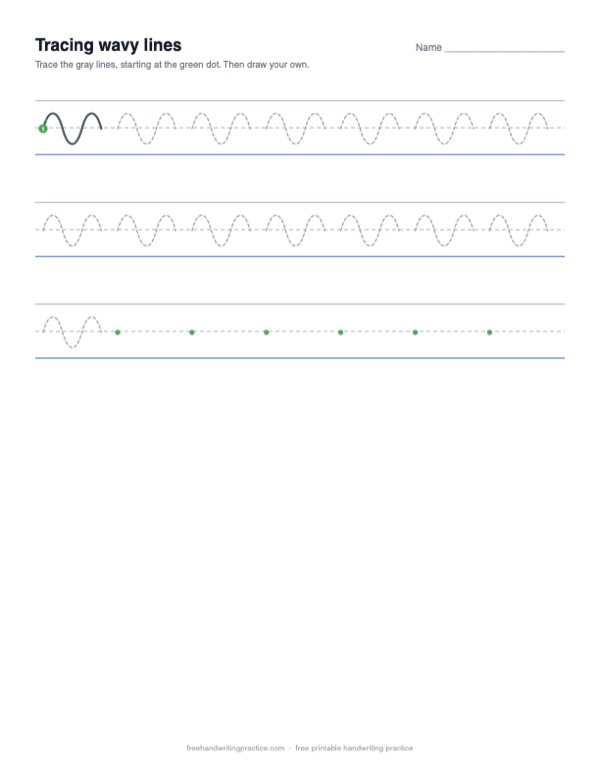
The wave: for each one, a row with a dark model (numbered green dots and an arrow show where to start and which way to go), a row of gray copies to trace, and a row with only green start dots to draw it alone.
How to draw each one
- Wave: Start on the left and roll up and down like a wave in the sea, without lifting the pencil.
Letters that use these strokes: s m n and cursive joins.
Or trace it on an iPad or phone
Trace with an Apple Pencil or a finger, then press Check for instant feedback on the path, the stroke order and the size. It runs in the browser, with no app and no sign-up.
- Trace the stroke
- Trace the light stroke
- Write it on your own
On-screen tracing is made for an iPad or phone
With a mouse or trackpad, tracing does not train the hand. Print the worksheet above and practice with a pencil. To trace with an Apple Pencil or a finger, scan the code with your tablet or phone camera to open this page there.
Waves versus zigzags
A zigzag has sharp points; a wave has round tops and bottoms. Doing both on the same day shows children the difference between stopping to turn and curving to turn, and they need both for letters.
Make waves everywhere
- Wave a ribbon or a scarf in big, slow curves, then draw the same wave on paper.
- Drive a toy car along a wavy road drawn in chalk.
- Draw the sea under a boat: small waves, then big waves.
Finished them all? Print a free Super Tracer certificate.